
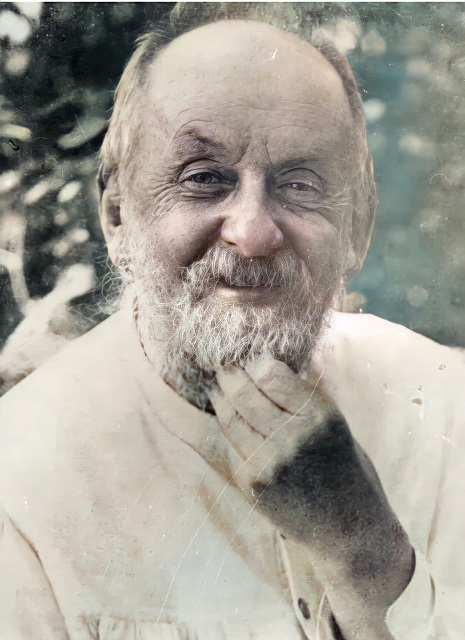
Prophet as mediator between “unknown intelligent forces” and Humans

Пророк Константин Эдуардович Циолковский

In the modern world many people are called prophets if the events they predict often come true. But doctors who determine the sex of an unborn child by using an ultrasound diagnostic device are not called prophets for some reason.

The deep meaning of the term “prophet” has been forgotten by people today. I will attempt to fill this gap.

A prophet is a person who contacts “unknown intelligent forces” (Nature, Gods, divine entities) and serves as a mediator between these forces and humanity, conveying their will to people in the form of prophecies. In this way, they explain the reasons for the occurrence of certain events that are hidden from the majority of people.

There is a saying: “A prophet reveals the will of the Gods…”

Throughout the history of modern humanity, there have been many such individuals. One example of a prophet is Konstantin Eduardovich Tsiolkovsky.

Konstantin Eduardovich Tsiolkovsky is known worldwide as the pioneer of modern astronautics, having developed the theory of rocketry. However, there is another lesser-known aspect of Tsiolkovsky, who used scientific methods to model the doctrine of the Universe’s creation and humanity’s place in it. These works by Tsiolkovsky are not widely known. Some of his prophecies have yet to be fulfilled and remain incomprehensible to representatives of modern science. But time inexorably brings the onset of these events closer…

Konstantin Tsiolkovsky attempted to look into the distant historical periods of the Universe’s development that are “beyond human comprehension” and tried to describe these periods in simple human language. Today, his articles are accessible to readers, such as “Unknown Intelligent Forces” (Russian), “Monism of the Universe” (Russian), “Wandering Atoms” (Russian), and many others.


“In fact, Tsiolkovsky was in constant contact with the unknown intelligent forces of the Universe. Writer Viktor Shklovsky, who met the famous sage several times and specifically traveled to Kaluga for that purpose, recorded the following conversation:

Tsiolkovsky asked me:
– Do you talk to angels?
– I answered softly, “No”.
– “By the structure of your head, you could talk to them”.
– “And you?” I asked.
– “I talk to them constantly.”
I was not frightened, understanding that an angel is inspiration.
– “They constantly disagree… the facts have a heavy nature, they depart without completing the conversation”.
(From a conversation between writer Viktor Shklovsky and Konstantin Eduardovich Tsiolkovsky, 1935)


“…The writer Shklovsky (who, it should be noted, had an disproportionately large and cleanly shaved ‘Martian’ skull) was not afraid of the revelations of the sage. Others were taken aback. Some simply shrugged their shoulders, saying that the old man was acting strange and should see a psychiatrist. And as for what he had written, it was better to keep it hidden away. Tsiolkovsky, on the other hand, considered angels to be higher intelligent beings, more perfect than humans. According to his concept, humans in the future, through cosmoanthropogenic evolution, would transform into angels. ‘Humans will also transform,’ he wrote in the early 20th century, ‘and the old, sinful human, a predator and killer, will no longer exist on Earth. Instead, there will be their descendants, perfect angelic beings.”

Valery Demin, “Tsiolkovsky”, the series “Remarkable People’s Lives” (Russian).

Konstantin Tsiolkovsky suggested that together with people inhabit beings and entities of other worlds, just their bodies are created from less dense matter, still unknown to us, and they are invisible to us, but their power is very great, as the period of their evolution may far exceed the evolution of human beings, and perhaps the age of our universe…

But representatives of modern science, in contact with “intelligent forces” unknown to most people, are afraid to even mention this ability. And in the academic science there is a “taboo” imposed on researches in this direction for many hundreds of years. For wilfulness researchers are threatened with a ban on publications in scientific journals, closing of access to grants, dismissal, etc. Such researchers (when discovered) are wished by those around them to be brought into a similar, so-called “normal” state to them. That is why many of them have chosen “silence is gold” as a slogan of their life path…  Otherwise, they will never escape grief.

Сжигание на костре ведьм, колдунов, вещунов, прорицателей...


Today such people are not burned at bonfires, not drowned in water and not beheaded, as it was done only a few centuries ago, but in principle, nothing has changed…

Modern researchers need to take responsibility and not look for inhabitants of other planets living in the universe many millions of light years away from us, but to look for inhabitants of other worlds, which have been dwelling here with us for a long time… From my point of view, there are already all the necessary prerequisites for this, including specialists and instrumentation, which allows to start strictly scientific research in this direction…




Matter, Materials, and Fabrics of the Cosmos as the Substrate of Everything that Exists

Matter, Materials, and Fabrics of the Cosmos as the Substrate of Everything that Exists

“…you each have your own experiences, own incarnations. What is proof to one, as has been given, will not be proof to the other.”Edgar Cayce, «Readings» (5753—2)


What is the Cosmos?

The Cosmos (in the broadest sense) is everything that exists.


What is the Universe?

The Universe is everything that is available for human beings to know.

“The Universe is a concept that refers to everything that is within the reach of optical or radio telescopes, not what mischievous or insane mathematicians have “written in” beyond that.” (Victor-Alfred Veynik)

Modern researchers understand the Universe as everything that formed after the Big Bang and continues to form to this day.


What is “matter”?

Matter (in the broadest sense) is a philosophical category that encompasses everything that makes up the “composition” and “content” of the Universe and determines all of its properties. The word “matter” in Slavic languages has long been a synonym for the word “fabric,” and the fabric of the Universe serves as the basis for the production of woven materials.

As Konstantin Tsiolkovsky stated in his article “My Philosophy” in 1932, “The universe consists of a single essence, which I call matter. This is unity, or monism.”


What is “material”?

Material is a substrate of a particular form of existence of matter, the elements of which are used by Nature (Creators, Makers, etc.) to create (make) the bodies (flesh) of objects.


Who are the “Creators” or “Makers”?

Creator (Maker) is a subject capable of embodying their thoughts and ideas into accessible matter and performing this activity.

Each object in the world (in the broadest sense) was created by someone.

Most objects in the world were created not by humans, but by someone or something else. Human beings also represent the result of someone else’s activity. Each person calls this “inventor-inventor” something different: some call it Nature, some call it the Universe, some call it the Creator, some call it God, some call it Allah, some call it the Supreme Being, some call it panpsychism, or anything else, as long as this name does not contradict the worldview of that person. That is, believers do it in their own way, atheists do it in their own way, philosophers do it in their own way…

Essentially, for a created (made) object, its Creator (Maker) represents an administrator with administrator rights.

“I certainly don’t believe in a God who flies around on clouds. But I do believe in the intelligence of Nature. Apparently – this is God!” Boris Bolotov


Does anything “immaterial” exist in the Cosmos?

No. Everything that exists in the Cosmos and determines all of its properties is “material” in nature.

The term “immaterial” is erroneous and refers to any object whose body is constructed from elements that are different from the known substance. The use of the term “immaterial” is fundamentally incorrect because everything that exists in the Universe (in the broadest sense) is matter and is constructed from it. Therefore, the use (writing) of this term must always be enclosed in quotation marks.

As a rule, the term “immaterial” is usually used to refer to objects of the spiritual world or other worlds of the Cosmos that a human being cannot manifest (sense).


What is “programmable matter”?

Programmable matter is a type of matter that can change its physical properties (shape, density, structure, optical properties, etc.) in a programmable way, i.e. has an internally inherent ability to perform information processing.

Hypothetically, all matter is programmable. Everything looks approximately the same as in the computer world. There are simple gadgets, and there are complex gadgets. Accordingly, there are simple programming languages and complex programming languages.

Hypothetically, the distinguishing feature of the most complex programmable matter known to humans today is the presence of programmable modules such as DNA or RNA.

Accordingly, the Flesh of Human beings has its own operating system called the Soul, which its Creators can modify at will, using a specific programming language for this purpose.


Continue reading 

Cognizable information vs. Data, vs. Information, vs. Consciousness. The Origin of Terms and Their Interpretation

Cognizable information, Data, Information, Consciousness.  The Origin of Terms and Their InterpretationThe lack of unified interpretations of such terms as cognizable information, data, information, and consciousness has begun to have a negative impact on the development of modern science and technology. This has been particularly evident in the discussions on the subject of “Does chatGPT have or does not have consciousness?

I decided to fill in this gap.

Part 1. Cognizable information

Absolutely all objects, processes and phenomena in the Universe, from “elementary particles” to the largest star clusters, from bacteria to human beings, from all kinds of radiation to the creations of human hands, in fact are carriers/media of various information (that could be cognized/perceived/read) about their origin, activity, evolution, “life path”, current state, etc. in the smallest detail. This “cognizable information” can tell a lot to someone who is able to “reveal”, “perceive” and “read” it.

Example #1: Light coming to us from a distant star is a valuable source of information for astronomers and can help solve many mysteries about the nature and origin of the universe. Analyzing the spectrum of light can provide information about the distance to the star and its speed, as well as the composition of the gases in the galaxy. The detection of chemical elements in the light spectrum, which may be associated with life, may indicate the presence of life on planets in that star’s system. This light can tell us about the star itself, its age, size, temperature, and composition. Changes in the brightness of the star can indicate the presence of planets passing in front of it…

Example #2: An artist’s painting from many centuries ago can tell researchers a lot about the culture and history of the time when it was created. It can contain information about the social, economic, and political life at that time. Also, it may reflect lifestyle, fashion, structure of the society, and even behavior of the people depicted in it. A painting can also show the architecture, landscape, and technological advances of the time. The size of the painting, the type of paint, the chemical composition of the paints, the material of the canvas, the author’s signature on the painting, etc. are also of interest to researchers.

Example #3: A handwritten letter can provide a variety of information for different subjects: for the addressee – it’s the content itself; for the graphologist – it’s the handwriting, containing information about the author of the letter; for the forensic scientist – it’s fingerprints on the letter, the composition of the ink and the paper the letter was written on; etc.

But… In the process of cognition some subjects can “read” this or that information, while others cannot do this for any of the reasons (lack of appropriate education, lack of necessary knowledge and experience, lack of desire to cognize anything, malfunction in functioning of the body and its receptors, and so on). Therefore, as a rule, people call “a source of information” only those objects, from which they are able to “read” what these objects “carry“.

Example #4: If a researcher of the Mumba-Yumba tribe does not know their language, he will not understand a single word or “catch” the slightest meaning in their speech. Everything uttered by the tribe will be mere noise to him.

Example #5: One subject (hunter) is able to “read” animal tracks, another (ornithologist) is able to “read” bird voices, a third (programmer) is able to “read” program code in a programming language he knows, a fourth (translator) is able to “read” texts in various world languages, a fifth (radio engineer) is able to “read” signals coming from radio stations to radio receiver using devices that people have specially created for this purpose…. and yet many people have no idea about the very possibility of “reading” this information…

Accordingly, it can be stated that:

  • Cognizable, or readable, information (rus. сведения, ukr. відомості) is everything that serves as a basis, on which a subject is able to characterize something.
  • Cognizable information does not exist by itself; it does not exist outside of the object – its carrier (i.e., medium)!
  • Cognizable information is, by default, unknown to the subject, but could potentially be cognized by him.
  • Cognizable information is an integral part of any object in the Universe, which the subject is able to perceive.
  • Creators of “cognizable information are Creators of objects or processes, i.e., Nature, Beings, as well as human-made devices.
  • A carrier, or a medium, is a conventional name of an object from the body of which a subject is able to perceive, or “read” “cognizable information“, which the object “carries on itself” by means of any physical effects.
  • The medium of “cognizable information is the conventional name for the carrier “carrying” the “cognizable of information”, which is unknown to the subject by default.
  • The medium of information is the conventional name for the medium “carrying” the information the subject has created.
  • Characterizing (describing, outlining, qualifying…)  is identifying and describing characteristic features and properties of something or someone.  
Anything is characterized, as a rule, using of any parameters used in scientific research at the current moment in time. Such physical parameters can be, for example, the size and shape of the surface, temperature, speed of movement, humidity, chemical composition, and so on. Such psychological parameters may be, for example, temperament, character, behavior pattern, personality type, personality traits, mental and psychological health of the individual, etc.

Continue reading 

What is information?

Information

Books on shelves in a library or a bookstore are full of all kinds of “cognizable information“, but for people who have not read them before, these books are nothing more than a potential “source of information“. The “cognizable information” these books “carry”, for the most part, is unknown to future readers. A book that a person has not read cannot bring him anything new, nor can it increase his knowledge. However, it remains a carrier of “cognizable information” until the paper, the carrier of this “cognizable information“, decays…

It is worth noting that the “cognizable information” didn’t appear in books by chance – it is a result of the process of creation of these books by a certain subject, which we conventionally call the Creator.  A book has a number of creators. Everyone who took part in its creation can be included in this category: the writer, the proofreader, the artist, the designer, as well as all those who printed this book…

Similarly, every object in the Universe has its Creators. For example: for a “galaxy” object the role of Creator belongs to Nature; for “program code” object the role of Creator may belong not only to a human-programmer, but also to a computer system with artificial intelligence elements…

A book is a carrier of “cognizable information” that is already known to someone. And information, by itself, is not a form of knowledge. To acquire knowledge, the subject needs to comprehend previously acquired information and become aware of it. “Сognizable information” “transferred” by books can become known for their readers only after they have made efforts (spend personal energy) to read these books and think about what they have read. In the process of reading books, the reader can discover something new for himself and create (produce) on its basis information which becomes a part of his knowledge pool.

The process of interpretation enables the subject to:

  • “read” the information;
  • identify the meaning in the contents of the information;
  • to create information if the information “bears” something new for the subject;
  • “expand” one’s knowledge and consciousness.

The subject, as a rule, gives the information, which he/she creates, a particular form, i.e., formalizes it. For example: an article, an essay, a story, a myth, a byline, a tale, a fable, a parable, an anecdote, a proverb, an image, code, an algorithm, a video…, can represent different forms (formalizations) of the same information …. which can be placed on any media (paper, CD, DVD, web pages in a network, etc.). Therefore, the term ‘information’ can be interpreted as “in-formation”, i.e. the process of giving a form (in-formatio), and the term “the carrier of information” can be interpreted as a conventional name of an object which “carries” on itself the information created by a subject.

As a result, when the formalization process of all information “born” (produced) by one subject is completed,  it becomes “cognizable information” (“source of information”) for all other subjects, as it represents something that is unknown to them.

Information (рус. информация, укр. інформація) is a product, created (produced, born, formed) within a subject during the process of his activity and represents “cognizable information” about the surrounding world that is comprehended and interpreted by the subject and refracted through his knowledge and life experience. That is, in its essence, information is the contents of one’s thought, which is recorded on some carrier. 

Information (from latin informātiō “representation, notion of something”, informare – “to give form, shape, thought, imagination”) is “cognizable information” ( regardless of the form it’s presented in), which is perceived by the subject, comprehended and interpreted by him.

The main difference between “cognizable information” and information is as follows:

  • Cognizable information” is a set of records (a set of statements) which are already known to someone, i.e. represent the contents of someone’s thought, recorded on some carrier.
  • Information is a set of statements (a set of facts) which are already known to the subject, i.e., represent the contents of a subject’s thought, recorded on some carrier.

Basic properties of information

  1. Information is material, because it requires a material carrier.
  2. Information is created (produced, formed, born) exclusively inside a subject in the process of his / her activity.
  3. Information that is lost and not preserved in any copy cannot be restored.
  4. Information is invariant with respect to a material carrier, i.e.:
  • The same information can be encoded in different ways (a verbal message can be encoded by sound waves; by nerve signals in the process of speaking; by signs written on paper…).
  • The same information can be recorded on different media (a book, a video, a web page on the web…).
  • Different information can be recorded on the same medium (notebook).
  • Information can be duplicated, modified, destroyed, etc…


What is Cognizable information?

Cognizable informationAbsolutely all objects, processes and phenomena in the Universe, from “elementary particles” to the largest star clusters, from bacteria to human beings, from all kinds of radiation to the creations of human hands, in fact are carriers/media of various information (that could be cognized/perceived/read) about their origin, activity, evolution, “life path”, current state, etc. in the smallest detail. This “cognizable information” can tell a lot to someone who is able to “reveal”, “perceive” and “read” it.

Example #1: Light coming to us from a distant star is a valuable source of information for astronomers and can help solve many mysteries about the nature and origin of the universe. Analyzing the spectrum of light can provide information about the distance to the star and its speed, as well as the composition of the gases in the galaxy. The detection of chemical elements in the light spectrum, which may be associated with life, may indicate the presence of life on planets in that star’s system. This light can tell us about the star itself, its age, size, temperature, and composition. Changes in the brightness of the star can indicate the presence of planets passing in front of it…

Example #2: An artist’s painting from many centuries ago can tell researchers a lot about the culture and history of the time when it was created. It can contain information about the social, economic, and political life at that time. Also, it may reflect lifestyle, fashion, structure of the society, and even behavior of the people depicted in it. A painting can also show the architecture, landscape, and technological advances of the time. The size of the painting, the type of paint, the chemical composition of the paints, the material of the canvas, the author’s signature on the painting, etc. are also of interest to researchers.

Example #3: A handwritten letter can provide a variety of information for different subjects: for the addressee – it’s the content itself; for the graphologist – it’s the handwriting, containing information about the author of the letter; for the forensic scientist – it’s fingerprints on the letter, the composition of the ink and the paper the letter was written on; etc.

But… In the process of cognition some subjects can “read” this or that information, while others cannot do this for any of the reasons (lack of appropriate education, lack of necessary knowledge and experience, lack of desire to cognize anything, malfunction in functioning of the body and its receptors, and so on). Therefore, as a rule, people call “a source of information” only those objects, from which they are able to “read” what these objects “carry“.

Example #4: If a researcher of the Mumba-Yumba tribe does not know their language, he will not understand a single word or “catch” the slightest meaning in their speech. Everything uttered by the tribe will be mere noise to him.

Example #5: One subject (hunter) is able to “read” animal tracks, another (ornithologist) is able to “read” bird voices, a third (programmer) is able to “read” program code in a programming language he knows, a fourth (translator) is able to “read” texts in various world languages, a fifth (radio engineer) is able to “read” signals coming from radio stations to radio receiver using devices that people have specially created for this purpose…. and yet many people have no idea about the very possibility of “reading” this information…

Accordingly, it can be stated that:

  • Cognizable, or readable, information (rus. сведения, ukr. відомості) is everything that serves as a basis, on which a subject is able to characterize something.
  • Cognizable information does not exist by itself; it does not exist outside of the object – its carrier (i.e., medium)!
  • Cognizable information is, by default, unknown to the subject, but could potentially be cognized by him.
  • Cognizable information is an integral part of any object in the Universe, which the subject is able to perceive.
  • Creators of “cognizable information are Creators of objects or processes, i.e., Nature, Beings, as well as human-made devices.
  • A carrier, or a medium, is a conventional name of an object from the body of which a subject is able to perceive, or “read” “cognizable information“, which the object “carries on itself” by means of any physical effects.
  • The medium of “cognizable information is the conventional name for the carrier “carrying” the “cognizable of information”, which is unknown to the subject by default.
  • The medium of information is the conventional name for the medium “carrying” the information the subject has created.
  • Characterizing (describing, outlining, qualifying…)  is identifying and describing characteristic features and properties of something or someone.  
Anything is characterized, as a rule, using of any parameters used in scientific research at the current moment in time. Such physical parameters can be, for example, the size and shape of the surface, temperature, speed of movement, humidity, chemical composition, and so on. Such psychological parameters may be, for example, temperament, character, behavior pattern, personality type, personality traits, mental and psychological health of the individual, etc.

Part 2. Basic properties of “Cognizable information”

  1. “Cognizable information” is of material nature, because it is an integral part of a material object.
  2. The same portion of “cognizable information “ can be coded in different ways (a verbal message can be coded by sound waves; by nerve signals in the process of speaking; by signs, written on paper… ).
  3. The same object may contain different  cognizable information “ (see ‘an artist’s painting’).
  4. “Cognizable information” can be reproduced (imagine many copies of the same book).
  5. If completely lost, “cognizable information” cannot be recovered (hereditary information embedded in DNA will disappear irretrievably if the human body disintegrates into the simplest chemical elements after his death).
  6. Different objects can contain the same “cognizable information” (book, video, web page…).
  7. “Cognizable information” is always relative and depends on:
  • The type of the medium/carrier;
  • The method of encoding;
  • The ability and capacity of the researcher;
  • The goal the researcher has set for himself.